
What Is Makers Conclave? NIAT's Physical AI Build Event, Explained
Makers Conclave is NIAT's flagship Physical AI event a three day build where student hardware is judged to industry standard. Here's how it works.
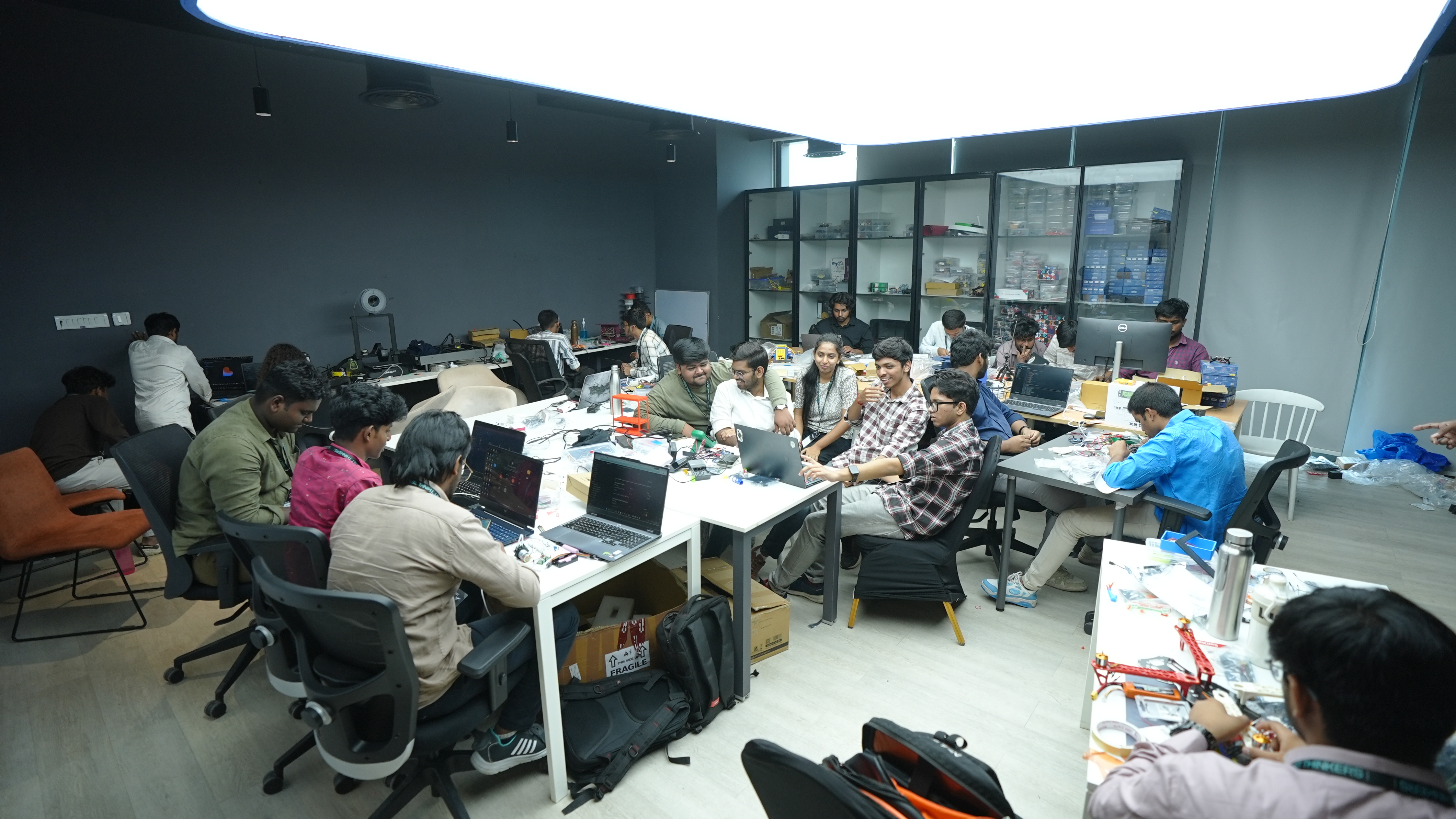
Makers Conclave is the hardware heart of TakeOver 2026, a three day Physical AI build event run by the NIAT Robotics Team, held 16 to 18 July at KKH Campus, Hyderabad. If you're seeing the name for the first time today, this is the full explainer: what it is, why it exists, how teams got here, and what happens over the next three days.
What Physical AI means here
Physical AI is machine learning embedded in hardware, systems that perceive the real world through sensors, make decisions on device, and act through motors, actuators, or alerts. It is the discipline behind autonomous drones, precision agriculture systems, medical monitoring devices, and industrial safety hardware. It is also meaningfully harder than pure software, because the physical world introduces noise, power limits, latency, and failure modes that no notebook environment reproduces.
Makers Conclave exists to make that discipline a live, competitive practice across the NIAT network rather than an elective interest.
Why the event exists
The objectives behind Makers Conclave are concrete and stated openly.
First, build a culture around Physical AI ahead of the Smart India Hackathon, the national competition that increasingly rewards end to end hardware capability. Makers Conclave is designed to generate pre buzz, surface talent, and normalise serious hardware work across campuses before the national season arrives.
Second, identify NIAT's strongest hardware projects and create a repeatable pipeline from student builds to high stakes national competitions. This isn't aspiration; it's a measured target. One of the event's success criteria is that a minimum of ten projects from this week are assessed by the Robotics Team as strong enough to develop further and pursue nationally.
Third, put student capability in front of industry professionals directly, not through slides or a curated video reel, but through working prototypes demonstrated live, with a jury free to probe anything.
How teams earned their place
Selection was competitive and multi stage: an open contest, followed by proposal submission, a mid level evaluation, and finals. The result is 54 teams, roughly 200 students, drawn from 14 campuses across the network. Every team on the expo floor this week earned its slot; nobody was nominated in.
The projects span six domains: health, agriculture, safety and transport, disaster response, environment, and smart systems. Several builds have already been deployed in real world settings, which is a meaningful bar, the distance between a lab demo and a deployed device is where most hardware projects quietly die. In keeping with competition rules, individual team identities and project details stay confidential until results are announced at Saturday's ceremony.
The three day format
Day 1, Thursday 16 July, is a full build day. After registration from 9am and orientation, teams are assigned build zones on the expo floor with tables and dedicated power, hardware kits are distributed, and the build phase runs through the day with Robotics Team mentors circulating. The day closes with a briefing on what comes next, and hardware is secured on the floor overnight.
Day 2, Friday 17 July, adds structure. The morning covers final build work and hardware testing, followed by two robotics workshop slots led by the Robotics Team on the main stage: an all teams session from 11am, and an advanced session from 3pm. The day ends with a final briefing on judging criteria, so no team walks into Saturday guessing what the jury values.
Day 3, Saturday 18 July, is the exhibition and the verdict. From 10am, industry guests and the jury walk the expo floor, watching live hardware demonstrations from all 54 teams. Jury deliberation begins late morning, and teams present on the main stage for live judging through the early afternoon. Results are locked by 4pm and announced at the combined TakeOver ceremony.
The standard is the point
What separates Makers Conclave from a typical campus tech exhibition is the evaluation bar. Projects here are judged to the same standard as national competitions like the Smart India Hackathon, which means functional demonstration, technical depth, and real world applicability, not presentation polish. A device that works reliably in front of a jury outranks a beautiful concept that doesn't.
That standard changes student behaviour in useful ways. Teams design for demonstration, not description. They think about failure modes, because a live demo exposes them. They learn to explain their engineering decisions under questioning, because the jury will ask why this sensor, why this architecture, what breaks first.
And critically, every participant, whether they win or not, leaves having built a prototype that functions in the real world before they graduate. For an 18 or 19 year old engineering student, that is a portfolio asset and a confidence asset that no course credit replicates.
Where it sits inside TakeOver
Makers Conclave is one of five streams at TakeOver 2026, and understanding its position clarifies its role. BRAVE tests commercial execution, revenue verified student businesses pitching to investors. The TakeOver Hackathon tests raw technical performance under a hard clock. NIAT Code Quest tests algorithmic depth pointed at national competitive programming. The GRIT Awards recognise sustained achievement across nine categories.
Makers Conclave's slice of that portfolio is specific: it tests whether students can make intelligence work in the physical world, the full stack from mechanical design through electronics and firmware to the model itself, integrated into a device that performs live. No other stream demands that breadth, and no other stream carries the same demonstration risk: a hackathon submission can be evaluated after the fact, but hardware either runs in front of the jury or it doesn't.
It's also the only stream that owns all three days of the event. Day 1 belongs to it entirely, the other 1,150+ students don't arrive until Friday, which gives the hardware teams something every builder recognises as precious: a full day of uninterrupted floor time before the campus fills. By the time TakeOver hits its Friday operational peak, with all five streams running simultaneously across nine venue zones, the Makers Conclave teams will already be a day deep into their builds and shifting into workshop and testing mode.
What's at stake
The prize pool totals ₹3,00,000: ₹1,50,000 for the winner, ₹1,00,000 for the first runner up, and ₹50,000 for the second runner up, all announced at the combined ceremony on Saturday evening alongside the results of every other TakeOver stream.
But the more durable stake is the pipeline. Teams identified as nationally competitive don't pack up on Saturday and stop, their builds enter a development track pointed at national platforms. For the strongest teams on this floor, Makers Conclave isn't the destination. It's the qualifier.
Over the next two days we'll publish domain by domain spotlights from the expo floor, a look at how the Robotics Team runs mentoring, and a breakdown of what industry judges actually evaluate in a hardware demo. The build is underway.