
Domain Spotlight: Health-Tech Hardware at NIAT Makers Conclave
From assistive devices to cardiac monitoring, health is one of six domains NIAT students are building in at Makers Conclave 2026.
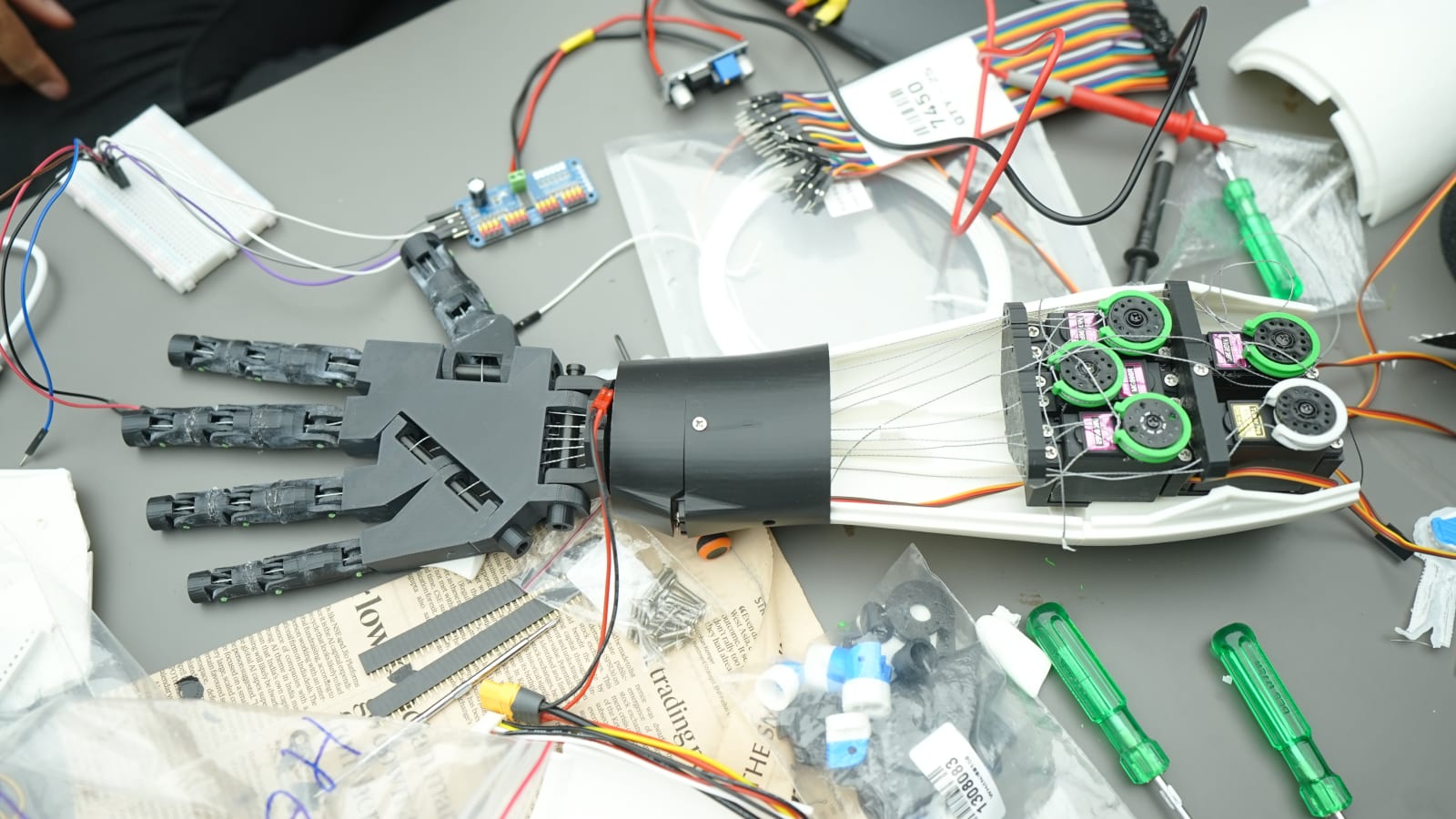
Health is one of the six project domains represented on the NIAT's Makers Conclave expo floor this week, and arguably the one where hardware skill translates most directly into human impact. Over the next three days, we're spotlighting each domain in turn: the problem space, what makes it technically demanding, and why student work here matters beyond the event. Health goes first, because the constraint that defines it defines serious hardware everywhere.
The problem space
The health tech teams at Makers Conclave are working across a broad but coherent territory: assistive and prosthetic devices, cardiac event monitoring and alerting, predictive screening built on affordable sensors, and preventive health tracking rooted in accessible, everyday practice, including approaches that draw on traditional wellness frameworks rather than importing assumptions from elsewhere.
What unites these builds is a common constraint, and it's worth stating bluntly: medical adjacent hardware has to be reliable, affordable, and usable outside a lab, or it doesn't matter. A blood oxygen sensor that's accurate on a bench but erratic on a moving wrist is a demo. A cardiac alert system that produces false alarms twice a day gets switched off within a week, and a switched off safety device is worse than none, because it manufactures false confidence.
Why health tech is a serious test of Physical AI
Every domain at Makers Conclave tests engineering capability. Health tests it with the least forgiveness, for four reasons.
Signal quality is adversarial. The human body is a hostile sensing environment: motion artifacts corrupt readings, skin tone and placement affect optical sensors, electrical noise from muscles interferes with cardiac signals. Extracting a trustworthy signal from that noise, cheaply, is a genuine engineering problem, not an integration exercise.
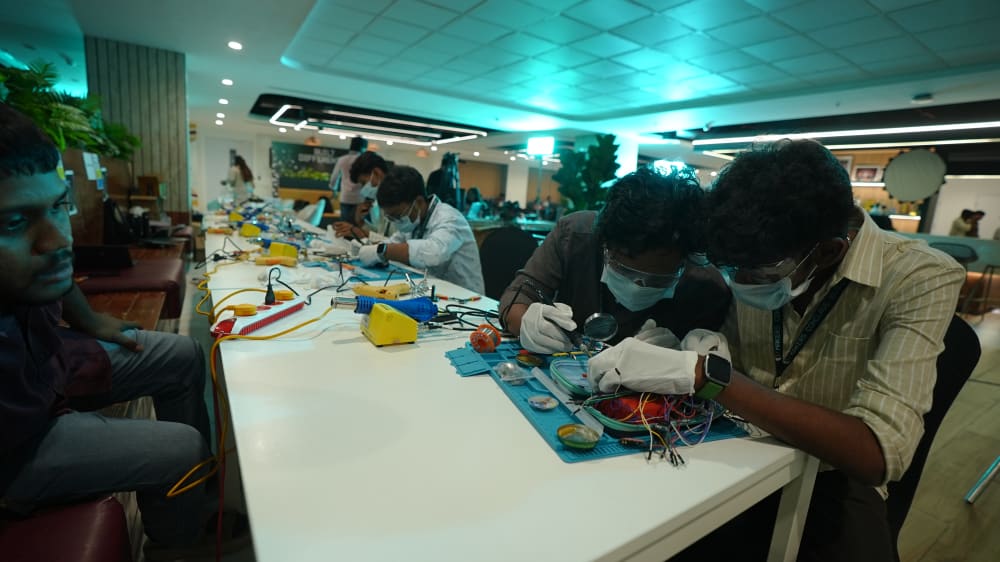
False positives and false negatives have asymmetric, serious costs. A screening device that misses a real event fails its entire purpose; one that cries wolf trains users to ignore it. Teams in this domain can't hide behind an aggregate accuracy number, the jury standing in front of them on Saturday can ask exactly how the device behaves at the margins, and "we haven't characterised that" is an answer with consequences.
Power and comfort are product requirements, not polish. A wearable that needs charging twice a day, or a prosthetic that's too heavy to wear through a working day, has failed regardless of how clever its intelligence is. Battery life, weight, and ergonomics are where health hardware succeeds or dies, and they force exactly the kind of whole system thinking Makers Conclave exists to develop.
And the usability bar is set by the least technical user. Health devices are used by patients, caregivers, and families, not engineers. If it needs a manual, it needs a redesign.
What building health tech teaches that other domains don't
For the students in this domain, the educational return is distinctive. Health hardware forces an early encounter with validation discipline: it isn't enough for the device to produce a number, the team must be able to say what the number was checked against, under what conditions, and how confident anyone should be in it. That habit of thinking in terms of ground truth, error bars, and edge case behaviour is the foundation of serious engineering everywhere, but most student projects never demand it. A gesture controlled robot that works "mostly" is a fine demo; a cardiac alert that works "mostly" is a hazard, and the team knows it.
The domain also teaches restraint in claims, a skill with career long value. Health adjacent projects live near regulated territory, and honest teams learn to describe precisely what their device does ("detects a pattern consistent with X and alerts a caregiver") rather than what a pitch deck wishes it did ("diagnoses X"). That precision under temptation is exactly what Saturday's jury rewards, and exactly what separates engineering maturity from enthusiasm.
Finally, health builds put students in contact with users whose needs are non negotiable. A prosthetic's user doesn't care about the elegance of the control algorithm; they care about weight, comfort, and whether it works every single time. Designing under that kind of accountability, at 18, permanently changes what a student considers "done."
The India context
India's health hardware gap is specific and well known: imported medical devices are priced for markets with different purchasing power, different infrastructure, and different failure tolerance assumptions. A monitoring device designed around reliable grid power and ambient air conditioning doesn't survive contact with much of the country it's sold into.
Affordable, locally built health hardware addresses gaps that imported devices priced for other markets never will, and the engineering discipline it demands has a name: frugal, deployment first design. Not "cheaper versions of Western devices," but devices designed from the first component decision around local cost, local conditions, and local users. Students building in this domain this week are practising exactly that discipline, at exactly the age where it becomes a permanent part of how they engineer.
What Saturday demands
Teams in the health domain will be judged, like every team on the floor, on whether the hardware actually works when an industry jury is standing in front of it. The Makers Conclave evaluation standard is explicit: national competition bar, meaning functional demonstration, technical depth, and real world applicability, not presentation polish.
For health builds specifically, expect the jury's questions to go where the domain's difficulty lives: How was sensor accuracy validated, and against what reference? What's the false positive rate, and how was it measured? What's the battery life under real use? What happens when the device fails, does it fail safe, and does the user know? Teams that have engineered honestly will have answers; teams that assembled a pipeline of parts will not, and the difference will be visible within two questions.
Why this domain rewards watching
Per competition rules, individual teams and projects remain unnamed until results are announced at Saturday's ceremony. But the domain itself makes a strong claim about what this NIAT (NxtWave of Innovations in Advanced Technologies) student network is capable of: 18 and 19 year olds choosing to build in the hardest constraint, highest stakes corner of Physical AI, where the evaluation isn't "is it impressive?" but "would this be safe and useful in a real person's life?"
Some of the builds on this floor have already moved beyond the bench into real world settings, clearing the deployment bar that most hardware projects, at any level, never reach. On Saturday, from 10am, the expo floor at NIAT KKH opens to industry guests and jury for live demonstrations from all 54 teams, with results at the 4pm combined ceremony.
Next in the domain spotlight series: agriculture, where the end user may not read English, connectivity can't be assumed, and the economics have to survive contact with a farm.