
54 Teams, 14 Campuses, One Floor: The Scale of Makers Conclave 2026
Makers Conclave brings 54 selected hardware teams from 14 NIAT campuses onto one expo floor. Here's what that scale means.
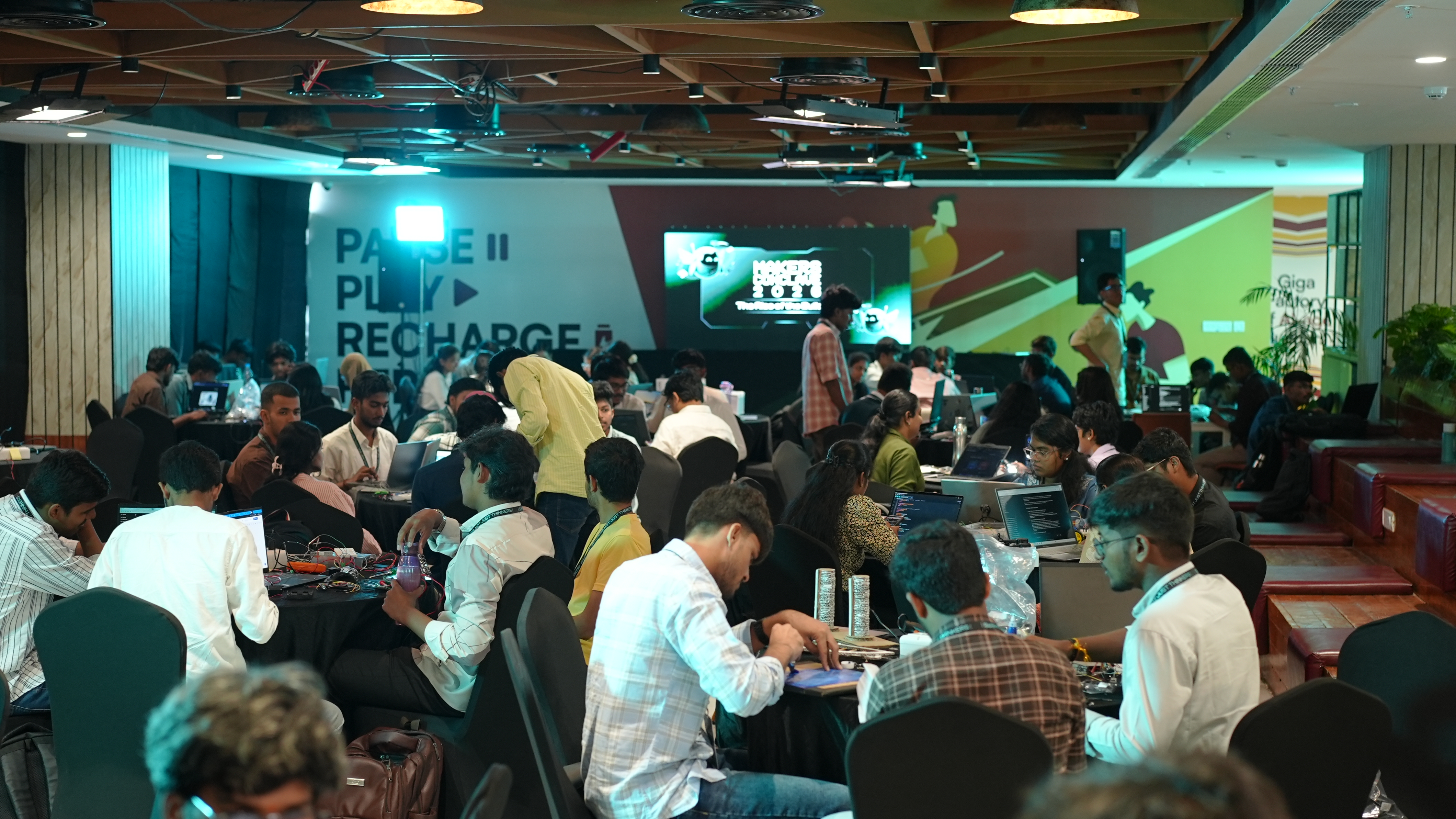
Fifty four teams. Fourteen campuses. Two hundred students. One expo floor.
That's the scale of Makers Conclave 2026 in four numbers, and each of them carries more meaning than a headline stat usually does. Here's why the scale of this event, not just its content, is the story.
Fifty four teams: a filtered number
Fifty four is not how many teams applied. It's how many survived a multi stage selection pipeline: an open contest, followed by proposal submission, a mid level evaluation, and finals. Every team on the floor this week earned its place against competition at its own campus before ever seeing this building.
That filtering changes the character of the event. This is not a come one come all maker fair where the range runs from serious builds to weekend curiosities. The floor is a concentration of the network's strongest hardware work, which means the internal competition is real, and the benchmark each team is measured against is no longer best at my campus but "best across fourteen."
Fourteen campuses: the first shared room
The inter campus dimension is the deliberate heart of TakeOver 2026. Until this week, these teams had never competed in the same room. Each knew its local standing; none knew its network standing. A team that dominated its campus selection rounds might arrive here and discover three other teams attacking the same problem domain with more sophisticated approaches, or discover that its own build is stronger than anything else on the floor.
Both discoveries are valuable, and both only happen in person. One of TakeOver's core objectives is exactly this: create a shared experience of excellence across the NIAT network, let students see at close range what their peers elsewhere are building, and raise the bar for what everyone aspires to next year. Leaderboards communicate rankings; a shared floor communicates standards. Watching a peer's deployed hardware actually run recalibrates a student's sense of what's possible at 18 or 19 far more durably than any number could.
Two hundred students: the right team size
Two hundred students across 54 teams puts the average team at three to four members, which, for hardware, is the honest size. Physical AI builds require at least three simultaneous competencies: mechanical design, electronics, and software/firmware, with integration as the fourth invisible job that someone must own. Teams of this size can't hide passengers. Every member on this floor is carrying real weight in their build, and Saturday's jury questioning, which probes individual understanding, not just team output, will make that visible.
Six domains, and a bar already cleared by some
The projects span six domains: health, agriculture, safety and transport, disaster response, environment, and smart systems. The spread matters because it demonstrates that Physical AI capability across the network isn't concentrated in one fashionable niche, it's being applied across the full range of problems that hardware can address in India.
One detail deserves particular attention: several builds on this floor are already deployed in real world settings. Deployment is the hardest bar in hardware. A prototype that works on a lab bench has solved the engineering problem; a device that survives real conditions, real users, and real time has solved the product problem. Teams arriving with deployed builds have crossed a gap that eliminates most hardware projects, and they set the reference point for everyone else on the floor.
In keeping with competition rules, team identities and project shortlists stay under wraps until results are announced at Saturday's ceremony. What we can cover, and will, in domain by domain spotlights over the coming days, is the problem spaces these teams are working in and what makes each technically demanding.
What 200 students on one floor makes possible
There's a second order effect of the scale worth naming: density of expertise. Fifty four teams across six domains means that whatever problem a team hits today, there is very likely another team on the same floor that has already solved a version of it. The drone team debugging its power distribution is thirty metres from a home automation team that fought the same brownout problem last month. The health tech team struggling with sensor noise can walk past an environment monitoring zone where signal conditioning is the entire project.
Campus level events can't produce that density, the local talent pool is too thin in any one specialty. Concentrating 14 campuses' selected teams creates, for three days, the richest peer expertise environment most of these students have ever worked inside. Some of the most valuable exchanges of the week will happen not through the formal mentoring layer but across zone boundaries, between teams that were strangers this morning and are comparing motor drivers by lunch.
That's also the inter campus culture objective operating at its most concrete level. Abstract "network building" happens through specific moments: borrowing a multimeter, explaining a calibration trick, discovering that the team from a campus 800 kilometres away chose the same microcontroller for the same reasons. Those threads persist after Saturday, and they're the connective tissue a national competition pipeline eventually runs on, when the strongest builds need cross campus collaborators.
One floor, then one stage
The physical arrangement of the event mirrors its logic. For the next two days, the expo floor is a workshop: 54 zones, each with tables and dedicated power, hardware secured overnight so work resumes without teardown. Mentors from the NIAT Robotics Team circulate continuously; tomorrow adds two workshop slots on the main stage alongside final build and testing time.
On Saturday, the same floor becomes an exhibition. From 10am, industry guests and the jury walk every zone and watch live demonstrations from all 54 teams, no videos, no simulations, hardware performing in real time or visibly failing to. Live judging follows on the main stage through the early afternoon, with every build evaluated to a national competition standard: functional demonstration, technical depth, real world applicability. Results lock by 4pm and are announced at the combined TakeOver ceremony, where a ₹3,00,000 prize pool is distributed, ₹1,50,000, ₹1,00,000, and ₹50,000 across the top three.
Why the scale is the strategy
It would be operationally easier to run 14 campus level showcases. TakeOver deliberately doesn't, because the concentration is the product. Putting the network's best hardware work in one building, in front of one jury, over one weekend does three things no distributed event can: it creates a single credible benchmark, it gives industry an unmediated view of the full network's capability in one visit, and it builds the inter campus culture that makes next year's selection rounds harder to win.
Fifty four teams are on the floor. By Saturday evening, three will hold prizes, at least ten are targeted for a national competition pipeline, and two hundred students will know exactly where they stand, not at their campus, but across the network. That's what the scale is for.